
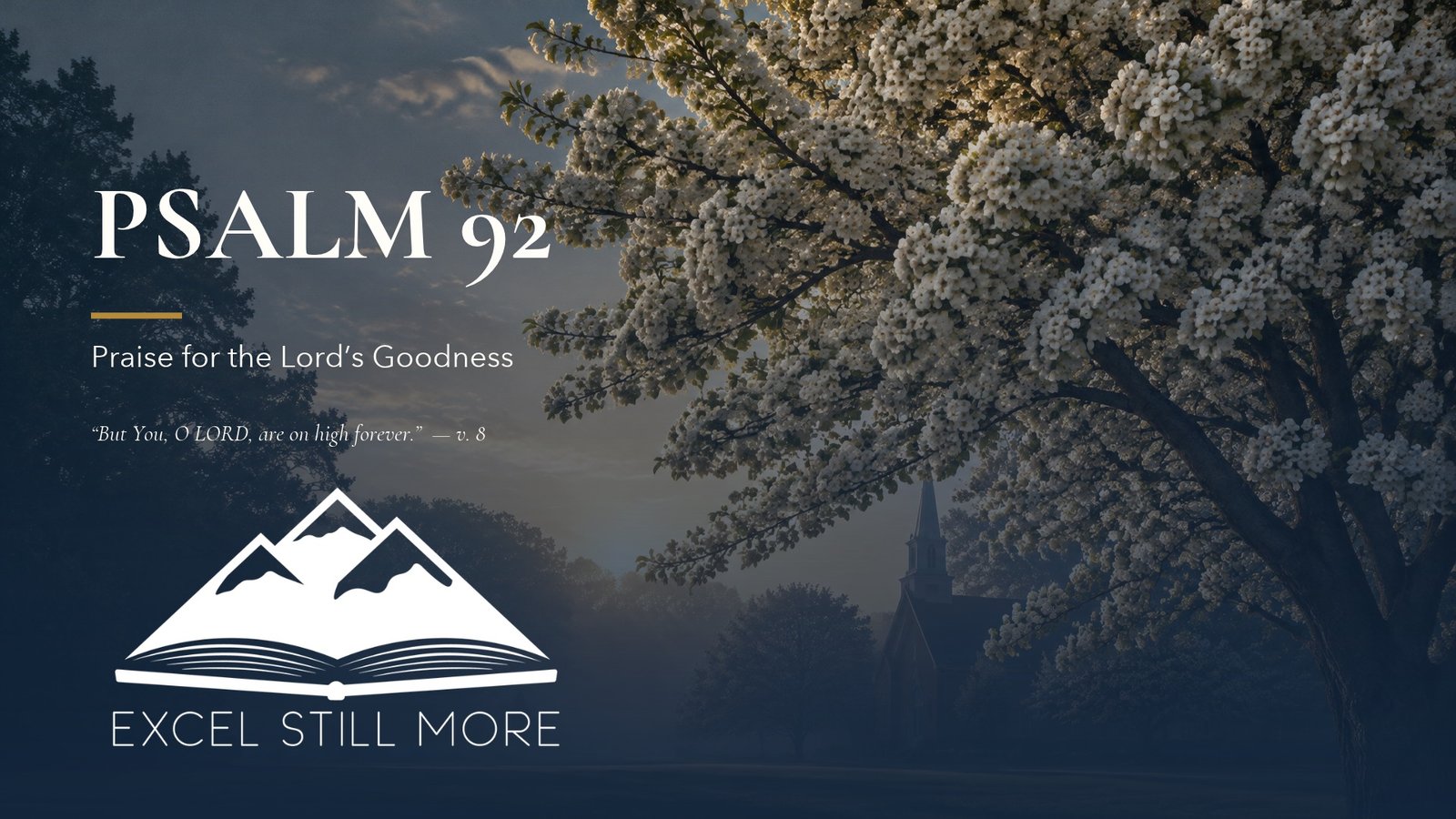
Every spring in Oklahoma, one tree steals the show.
For about two weeks, the Bradford pear explodes in white. It lines driveways, subdivisions, and bank parking lots from one end of the state to the other. Builders and homeowners planted millions of them, and the reason was simple: they grow fast, and they look good right away.
But anyone who has owned one knows what comes next. The Bradford pear is a short-lived tree with weak, upright branches that are notorious for splitting. It grows faster than its own wood can support, and somewhere around year fifteen it starts to come apart. One spring storm, and half the tree is lying across the driveway. The Bradford pear flourished. That was the problem. It flourished fast, with nothing underneath to hold it up.
Now drive a couple of hours east into the Cross Timbers, the strip of rough woodland running down through central Oklahoma. There you will find a tree nobody puts on a postcard: the post oak. Scraggly and stubborn, most of them never top forty feet. Loggers didn’t bother with them. They didn’t look like they were worth anything.
Then researchers from the University of Arkansas began taking core samples, and what they found was stunning. Millions of post oaks in the Cross Timbers are 200 to 400 years old. Thousands of them were already old growth when the United States declared its independence. Their secret is underground: “well-developed, strong roots work down into the bedrock.” As one Oklahoma rancher put it, “Them old post oaks on the ridges are tough as nails.”
So here is the question Psalm 92 puts to every one of us. If you stood in a front yard in April, which tree would you say was flourishing?
The Bradford pear. Every time.
But come back in twenty years. Come back after the ice storm. Come back in two hundred years.
The psalmist admits that the wicked “sprouted up like grass” and “flourished” (v. 7). They really do. From where we stand, it often looks like they are winning. But theirs is a flourishing with no roots, and it ends with them “destroyed forevermore.” The righteous flourish too (v. 12), but like the palm and the cedar of Lebanon: slowly, deeply, “planted in the house of the Lord” (v. 13). That is why “they will still yield fruit in old age” (v. 14).
What makes the difference? The answer sits at the very center of the psalm:
“But You, O Lord, are on high forever.” (v. 8)
The wicked are rooted in a moment. The righteous are rooted in the God who is forever.
Praise Is the Center
If there is one thing every one of us must grasp about the spiritual life, it is this: praising God lies at the center of it all.
Psalm 92 is many things at once. It is a poem that wrestles honestly with a hard question. It is a song of praise. It is a prayer of thanksgiving. Its title calls it “A Song for the Sabbath day,” and its words were meant to be both spoken and sung, declaring God’s lovingkindness in the morning and His faithfulness at night.
We do not know for certain who wrote it. But we can see clearly what he was wrestling with. He looked around and saw the wicked enjoying what he did not have. Perhaps he was working through that struggle himself. Perhaps he had already come through it and wanted to help others who were still in it. Either way, his conclusion is unmistakable: the wicked may prosper for a time, but the righteous flourish forever.
That is a call not to get caught up in the “right now.” Every faithful person is playing the long game with the Lord. He is forever, and those who belong to Him will be with Him for all of forever.
The Struggle Is Real
To appreciate Psalm 92, we need to understand a struggle that runs all through the Old Testament. Some call it the doctrine of retribution, and it can be stated simply: God always rewards the righteous and punishes the wicked, and He does it now.
The more I read the Old Testament, the more I see what a real struggle this was for God’s people. And we should not pretend we have outgrown it. We feel it too:
- Someone you know is living a terrible life and doesn’t deserve the raise. He gets it anyway.
- Someone as hateful as you can imagine seems to have everything you have ever wanted: money, land, a beautiful home, a big family, and people who flock to him.
- A man who has abused his body for years is declared cancer-free, while you have lived carefully and healthily, and the disease is eating you alive.
It is so easy to slip into that mindset: “I’m living a faithful life. Why am I the one struggling, while those people over there live wickedly and have it easy?” It can feel as if you are being punished for being good.
But that is exactly where the doctrine leads. When I am good, God will bless me now. When I am bad, God will curse me now. Nothing could be further from the truth.
Sometimes life is just life. Our circumstances are our circumstances, and we deal with what comes next. The question is never whether we will face hardship. The question is where our roots are when it comes.
Eddie Cloer captures the movement of this psalm well:
“The flow of thought in the first part of the song reflects the tension that often is seen between the rewards of righteousness and wickedness. In the second division, a clear resolution is given. The writer admits that the wicked may seem to prosper; however, he cuts through the way things look to the truth that their success is hollow and temporary. God, he argues, allows the disobedient to experience prosperity in order that they may provide a setting for Him to display His condemnation of evil. The psalm ends with a bold announcement that the certain triumph of justice is reason for the continual praise of God.”
The Shape of the Song
Psalm 92 is built as a chiasm, a mirror-image structure in which the first half reflects the second and everything points to the center:
- Declare the Lord Every Day (vv. 1–3)
- What the Fool Cannot See (vv. 4–6)
- The Grass That Withers (v. 7)
- The Lord Is Forever (v. 8)
- C′. The Enemies That Perish (v. 9)
- B′. What My Eyes Have Seen (vv. 10–11)
- A′. Declare the Lord All Your Life (vv. 12–15)
Notice what sits at the very heart of the song. Not the wicked. Not the righteous. The Lord. Everything else in the psalm turns on that one line.
Let’s walk through it.
Declare the Lord Every Day (vv. 1–3)
It is good to give thanks to the Lord And to sing praises to Your name, O Most High; To declare Your lovingkindness in the morning And Your faithfulness by night, With the ten-stringed lute and with the harp, With resounding music upon the lyre.
The psalm opens exactly where our spiritual lives ought to begin: with praise. And that praise springs from two things about God:
- His lovingkindness, which we declare in the morning.
- His faithfulness, which we declare at night.
Morning and night. Every day begins with His steadfast love and ends with His proven faithfulness, and the psalmist wants both bookends filled with praise. Why? Because he knows that all praise and thanksgiving belong to the Most High.
This is worship at its core, and it has three dimensions:
- Gratitude: the thanks we express to Him.
- Song: the praises we sing to Him.
- Declaration: the praise we speak and live before Him.
All three acknowledge the same two truths about who God is: He is loving, and He is faithful.
What the Fool Cannot See (vv. 4–6)
For You, O Lord, have made me glad by what You have done, I will sing for joy at the works of Your hands. How great are Your works, O Lord! Your thoughts are very deep. A senseless man has no knowledge, Nor does a stupid man understand this.
The works of God are undeniable, and they are worthy of all our praise. But not everyone sees them. Some aren’t looking. Some are blind to the goodness of God. Some simply refuse to see.
The psalmist can hardly fathom it, so he puts it plainly. The man who has no knowledge of God or the things of God is senseless. And the man who sees, yet fails to understand that everything he has in this life lasts only a moment, who imagines he will endure and keep it all forever without the forever God, is stupid.
Those are strong words. They are meant to be.
The Grass That Withers (v. 7)
That when the wicked sprouted up like grass And all who did iniquity flourished, It was only that they might be destroyed forevermore.
Everything we have on this earth is temporary at best. Success lasts a moment. Nothing here lasts forever. The wicked may seem to have it all right now, but they will hold it only for a moment in time.
Think of Jesus’ account of the rich man and Lazarus (Luke 16:19–31). The rich man’s comfort and luxury looked permanent, until they weren’t. And Lazarus’ suffering looked endless, until it wasn’t. What seems like forever in this life never is.
The psalmist compares the wicked to grass. It sprouts, greens, and flourishes for a season, then dies as quickly as it rose. But he adds a sobering note grass never had: the wicked will be “destroyed forevermore.”
That is the Bradford pear. Beautiful in April. Gone after the storm.
The Lord Is Forever (v. 8)
But You, O Lord, are on high forever.
Here is the main point of the entire psalm, the hinge on which everything turns.
Nothing stands as high as God, and nothing stands as long. Verse 1 called Him the “Most High,” and now we learn He is on high forever. Others may rise, but they will just as surely fall. The only thing in this life truly worth investing in is the Most High God, who alone is worthy of our praise and thanksgiving.
We may not sprout up and gather all the things the people around us seem to have: power, stability, money, family, recognition. But we were never meant to fix our eyes only on the moment we happen to live in. Our blessings are with God. From a New Testament perspective, God “has blessed us with every spiritual blessing in the heavenly places in Christ” (Ephesians 1:3).
It calls to mind the first and last three words of Psalm 23:
“The Lord is . . . the Lord forever.”
Never forget it.
The Enemies That Perish (v. 9)
For, behold, Your enemies, O Lord, For, behold, Your enemies will perish; All who do iniquity will be scattered.
At some point, for all of us, destiny meets reality. Evil men may flourish briefly, but the righteous will ultimately receive the blessing.
Verse 9 shows the two roads before every person:
- The wicked will perish like grass that springs up overnight. They will have no more, be no more, and experience the blessings of God no more. They will be scattered.
- The righteous will be blessed.
There is no third road.
What My Eyes Have Seen (vv. 10–11)
But You have exalted my horn like that of the wild ox; I have been anointed with fresh oil. And my eye has looked exultantly upon my foes; my ears hear of the evildoers who rise up against me.
The horn represents the power of the wild ox, its strength on full display. The anointing with fresh oil speaks of restoration, refreshment, and renewal. It is the picture of someone God has approved and revived, and that is deeply encouraging.
The works of God have brought victory. God has dealt with the enemy. His people have been lifted up.
The psalmist has seen the works of the Lord, both how He has worked within His people and how He has worked for them. He has seen God bless them in ways the world does not count as blessings. Maybe he watched it from a distance. Maybe he lived it himself.
To be with God is to experience something entirely different. It is to understand differently, to think differently, to see differently. The world points at its possessions and says, “This is a blessing.” The man of God answers, “Everything with God is truly blessed.”
Declare the Lord All Your Life (vv. 12–15)
The righteous man will flourish like the palm tree; he will grow like a cedar in Lebanon. Planted in the house of the Lord, they will flourish in the courts of our God. They will still yield fruit in old age; They shall be full of sap and very green, to declare that the Lord is upright; He is my rock, and there is no unrighteousness in Him.
Now the psalm comes full circle. It began with declaring the Lord every day. It ends with declaring Him all your life.
Because of the wisdom of God’s ways and His protection in times of stress, the righteous man enjoys true spiritual success. He flourishes like a stately tree. Throughout the Psalms, the godly in their steady growth are compared to the cedar, the palm, and the olive tree (Psalm 52:8). The palm, the queen of trees, was prized for its beauty, its fruit (Song of Songs 7:7), and its long life. The cedar of Lebanon was famous for its strength, its height, and its enduring wood.
The picture is clear. The righteous man is the healthiest and most fruitful person there is. Strength and excellence mark his life. Like the man of Psalm 1, he is “a tree firmly planted by streams of water” (Psalm 1:3), and he flourishes forever.
And notice where he is planted: in the house of the Lord. His roots go down into the bedrock of God Himself.
That is why he still bears fruit in old age. While the world assumes the best years are behind us once the hair turns gray, the psalmist says the righteous are “full of sap and very green.” They are spiritually alive, filled with the Most High God, and still producing. They understand that this is the quality of life worth pursuing. Nothing else matters.
Paul said it this way to the Christians at Corinth:
Therefore we do not lose heart, but though our outer man is decaying, yet our inner man is being renewed day by day. For momentary, light affliction is producing for us an eternal weight of glory far beyond all comparison, while we look not at the things which are seen, but at the things which are not seen; for the things which are seen are temporal, but the things which are not seen are eternal. (2 Corinthians 4:16–18)
Where Are Your Roots?
The Bradford pear and the post oak both stand in Oklahoma soil. In April, only one of them looks like it is winning. But the storms always come, and when they do, the question is never how fast you grew or how good you looked. The question is what you are rooted in.
The world will keep sprouting up like grass. Some people who want nothing to do with God will get the raise, the house, the applause, and the easy road. Let them have their April. It will not last.
You and I are playing the long game, with a God who is on high forever. So plant yourself deep in the house of the Lord. Praise Him when the sun comes up for His lovingkindness. Praise Him when the sun goes down for His faithfulness. Keep bearing fruit when your hair is gray. And with every season of your life, join the psalmist in his closing declaration:
“The Lord is upright; He is my rock, and there is no unrighteousness in Him.” (v. 15)