
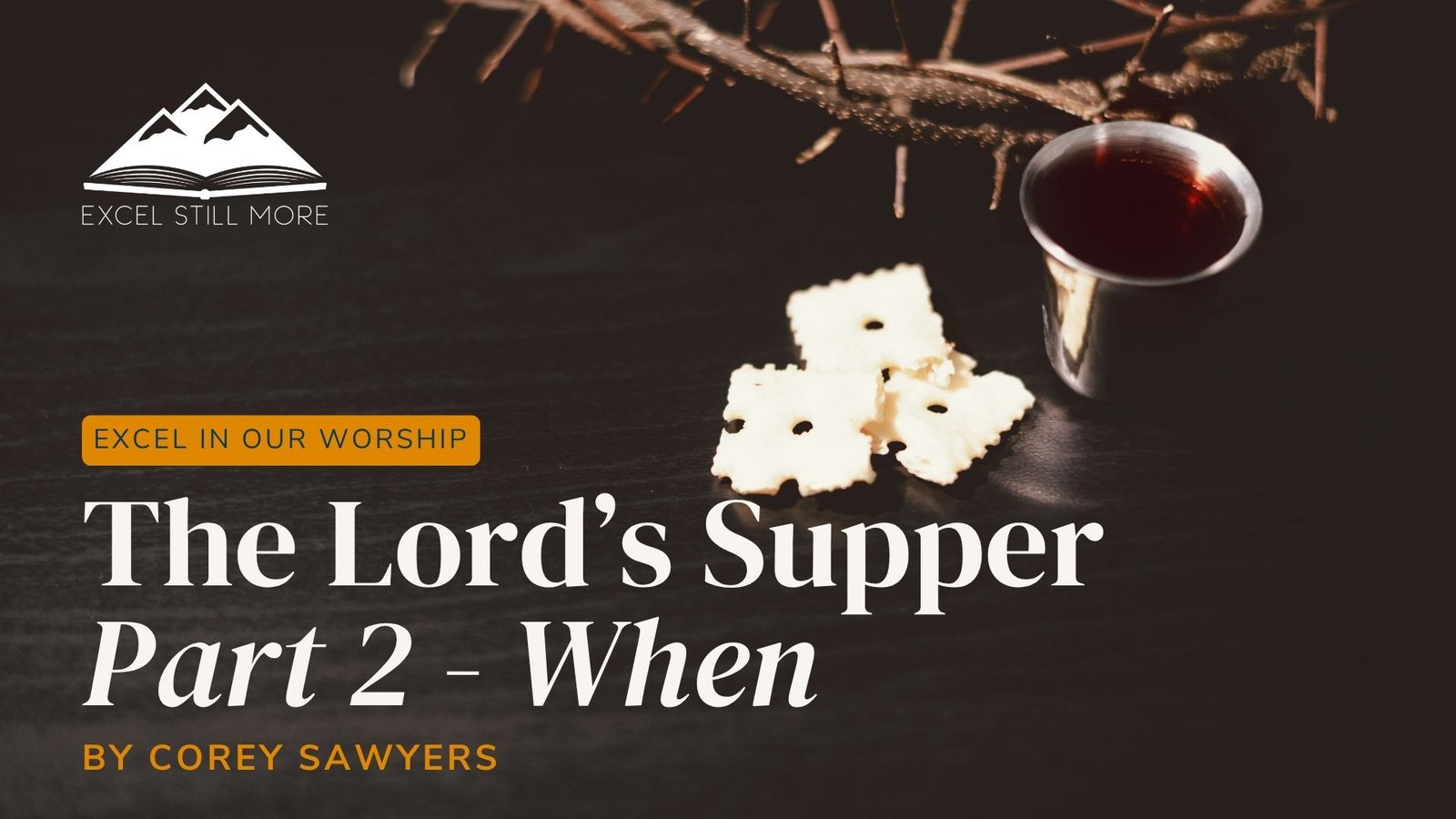
We began talking about the Lord’s Supper last week (click here for part 1). This particular act of worship was instituted by Jesus Christ Himself on the night of his betrayal. During the Passover Feast, in an upper room in Jerusalem, Jesus showed His disciples in what manner He wanted His followers to commemorate Him and His sacrifice for sins in Matthew 26:26–28; Mark 14:22–24; and Luke 22:19, 20.
Ultimately, the Lord’s Supper is a reminder or a memorial. Jesus said, “do this in remembrance of me.” (1 Corinthians 11:24-25). Remembering Christ’s death on the cross is the function of the Lord’s Supper. The purpose of the Lord’s Supper is a point so valuable that Paul emphasized it no fewer than three times recording for us that crucial reminder of carrying it out in remembrance of Christ. None of the Gospel accounts record it exactly the way Paul does in I Corinthians. However, since Paul received instructions from Christ (1 Corinthians 11:23), there is no doubting its accuracy. Each occasion in which the Lord’s Supper is partaken, it is intended to serve as a reminder of the glory of God’s saving grace and the story of the cross. It represents, seals, and applies the now accomplished redemption from sin and death until the end of time.
Scores of Jews met their demise by means of crucifixion during the days of the Roman Empire. It is not Jesus’s crucifixion, but rather His resurrection that makes the death of Jesus on the cross unique. The Gospel is (as accurately translated) “good news.” What makes the Gospel good news is the fact that He arose from the grave on the third day (cf. 1 Corinthians 15:1-5). It was on the first day of the week that Peter preached the Gospel for the initial time, and the church had its origin in Acts 2. It is fitting that it was on the first day of the week that the disciples assembled together to worship. One of those acts of devotion was the partaking of the Lord’s Supper (cf. Acts 20:7).
Paul emphasizes time when teaching about the communion. He says, “Therefore WHEN you meet together,” (1 Corinthians 11:20). The “when” of the communion is important. This is why we do not partake of the Lord’s Supper on a different day of the week. We also do not observe it on whatever day of the week upon which a holiday may fall. Because we want to do things the way in which the church of the New Testament did, we want to partake of Christ’s supper “WHEN” they did. It seems clear the early church ate the Lord’s Supper on the week’s first day of the week only. This is found to be true in scripture, and also in historical writings. Scripture, though, must be our guide.
Notice again in Acts 20, the brethren partook on the first day of the week. It seems that Paul delayed his departure for the very purpose of being able to be there with them on that first day of the week. He had to wait until the week’s first day. The church in the First Century came together on each week’s first day (1 Corinthians 16:2). In fact, the focal point of the assembly for the first century church was the breaking of bread. The first day of the week is THE day of the Lord’s Supper for every faithful child of God.
The question is often asked of how frequently we must eat the Supper. The Bible defines the frequency of partaking in this way – Paul says, “When you come together” (1 Corinthians 11:20). It was on the Lord’s Day, or the first day of the week, that they came together. Of course every week has a first day. So every first day of the week, the Lord’s Supper should be partaken.
Communion is a powerful, weekly reminder. It compels one to think about the suffering Jesus endured. It reminds us of the hope in Christ of the Gospel. Paul explains, “as often as you eat this bread and drink this cup, you proclaim the Lord’s death …” (I Corinthians 11:26). As often as the church partakes, the church proclaims! This is a wonderfully symbolic proclamation that always accompanies this special aspect of weekly worship.
As a part of the worship, communion is intended to show the world around the importance of Christ and the Christian’s relationship with Him. It is an opportunity to remind both those outside of Christ and each Christian of the significance of Jesus’s sacrifice of body and blood on the cross. It is a remembrance for those who have accessed the sacrifice Jesus made by obeying His gospel.
Paul writes “whoever eats the bread or drinks the cup of the Lord in an unworthy manner, shall be guilty of the body and the blood of the Lord” (I Corinthians 11:27). Some Christians find this verse torturous – some even avoid taking communion so they will not take it unworthily and be condemned. It is sad that there are some in the church who misunderstand this verse to suggest that they must be perfectly sinless in order to partake of the communion. Paul, in context, is writing about the selfish and unchristian attitudes some demonstrated when they partook. They were divided while taking communion. What an oxymoron! He is not writing to imply Christians must be flawless before they can be acceptable to worship the King. Doing so every first day of the week reminds us of our unity, and proclaims the good news to all. Each week as we eat and drink with that mindset motivates us to forsake all sin and live devoted to His service.