
We began looking at the Lord’s Supper a few weeks ago (click for part 1 and part 2). Instituted by Jesus Himself on the night of His betrayal, the Lord’s Supper shows the manner in which He wanted His followers to commemorate Him and His sacrifice for sins. It is recorded for us in three of the Gospels (Matthew 26:26–28; Mark 14:22–24; Luke 22:19–20).
One should examine himself or herself before partaking of communion. An honest evaluation of oneself, one’s relationship with the Lord, and one’s relationship with other followers of Jesus is necessary. The mind should be focused upon the suffering Savior. Following this self-examination, the actual partaking of the Supper is at hand. While the Bible does not specifically state, “You must complete this first and then this,” it seems, at the very least, prudent to partake of it in a certain order. This is true for two reasons. First, every biblical account follows the same order. Second, recorded history, with only a few rare exceptions, shows the church following the same pattern all the way back to the first century.
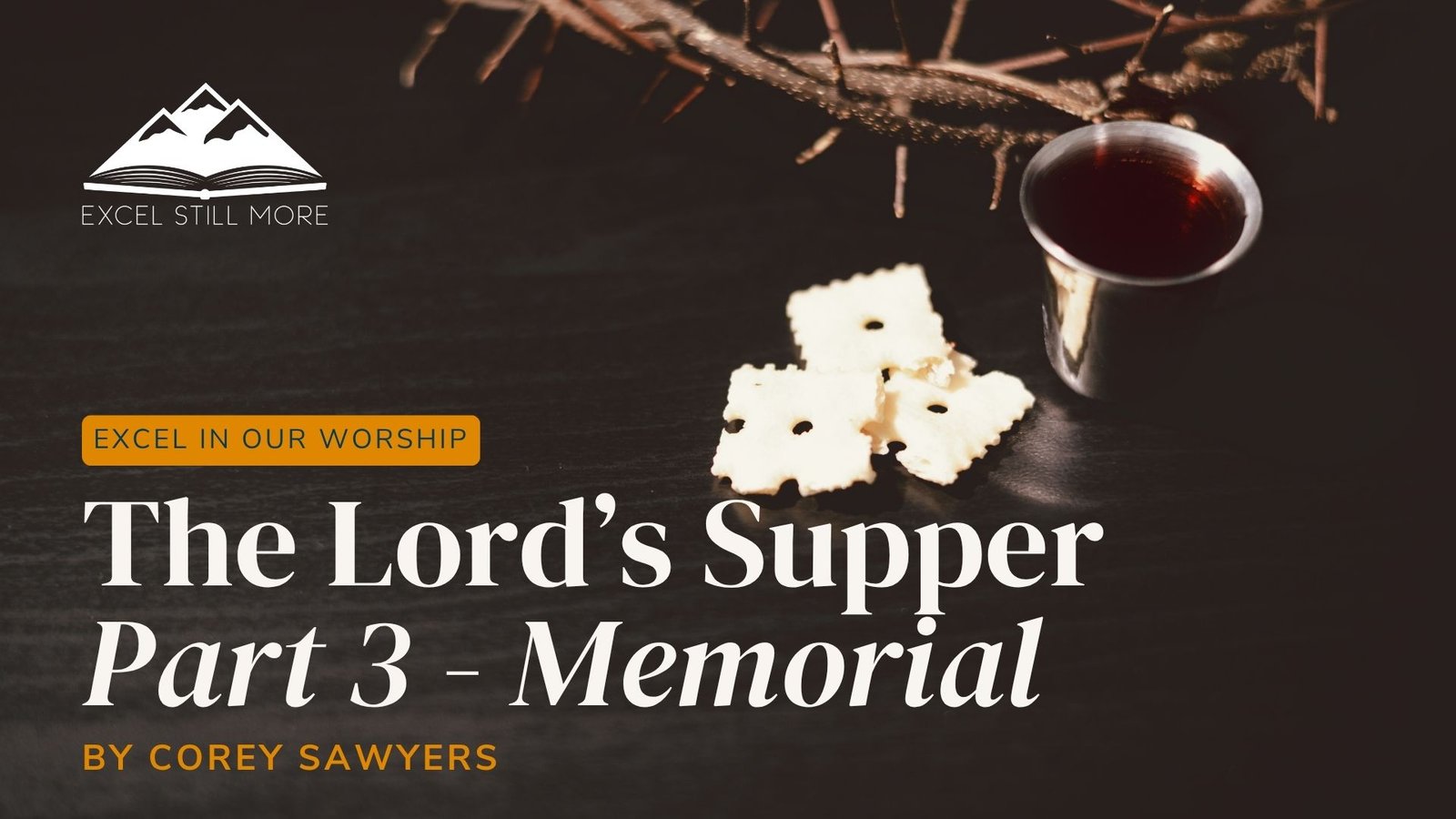
Jesus took the bread, or picked it up. The word translated bread can also be defined as loaf. He gave thanks for it and then broke the bread. It was customary at that time for hosts to break the bread for their guests. It is incorrect to conclude that this means Jesus’ body was broken, even though some translations include additional wording. His skin was pierced, but neither His body nor His bones were broken, as John’s Gospel clearly shows (John 19:33–36).
The emphasis is on the fact that the bread represents the body of the Bread of Life (John 6:35). When Jesus said the bread was His body, He did not mean that it was literally His flesh. Rather, He was establishing a symbolic relationship. Luke records that after Jesus said, “This is my body,” He added, “Do this in remembrance of me.” The bread and the cup do not present the body and blood of Christ; they represent them.
The second part of the observance is known by several names, including “the cup,” “the fruit of the vine,” and “the wine.” Paul’s record of Jesus’ words closely parallels Luke’s account. The central point is that this fruit of the vine represents the new covenant established by Jesus’ blood.
As the Supper is partaken of, participants “proclaim the Lord’s death” (1 Corinthians 11:26). Our observance of the Supper is indeed a powerful message. To whom is this message proclaimed, and how is it proclaimed? These questions point us to the central focus of Christianity. Jesus was more than a prophet, a rabbi, or simply a good man. He was the unique, one-of-a-kind Son of God. His death and burial demonstrate the Lord’s love for mankind, while His resurrection declares His deity. It also gives those who are in Him the hope of life beyond this earth—the glorious hope of eternal life with Him in the paradise of heaven. Paul viewed the Lord’s Supper as a proclamation of the gospel, reminding both Christians and all who witness it of the saving message of Christ.
Communion is a powerful weekly reminder. It compels us to think about the suffering Jesus endured. It reminds us of the hope found in Christ through the gospel. Paul explains, “For as often as you eat this bread and drink the cup, you proclaim the Lord’s death…” (1 Corinthians 11:26). As often as the church partakes, the church proclaims. This is a wonderfully symbolic proclamation that always accompanies this special act of weekly worship.
The Lord’s Supper is a beautiful and fitting memorial of the greatest sacrifice and display of love in all of history. As Christians partake, they remember the death, burial, and resurrection of the Lord. No matter where you are—in prison, in Africa, in Hydro, Oklahoma, or in Martin, Tennessee—it is remarkable to think that Christians around the world are remembering the body and blood of Jesus. Our fellowship in that sacred feast may be the single strongest bond among believers of every culture on this side of heaven. Like so many aspects of the Christian life and the work of the church, it is easy to lose sight of just how remarkable and marvelous this truly is. We sometimes sing:
“Precious feast, all else surpassing,
Wondrous love for you and me;
While we feast, Christ gently whispers,
‘Do this in My memory.'”