
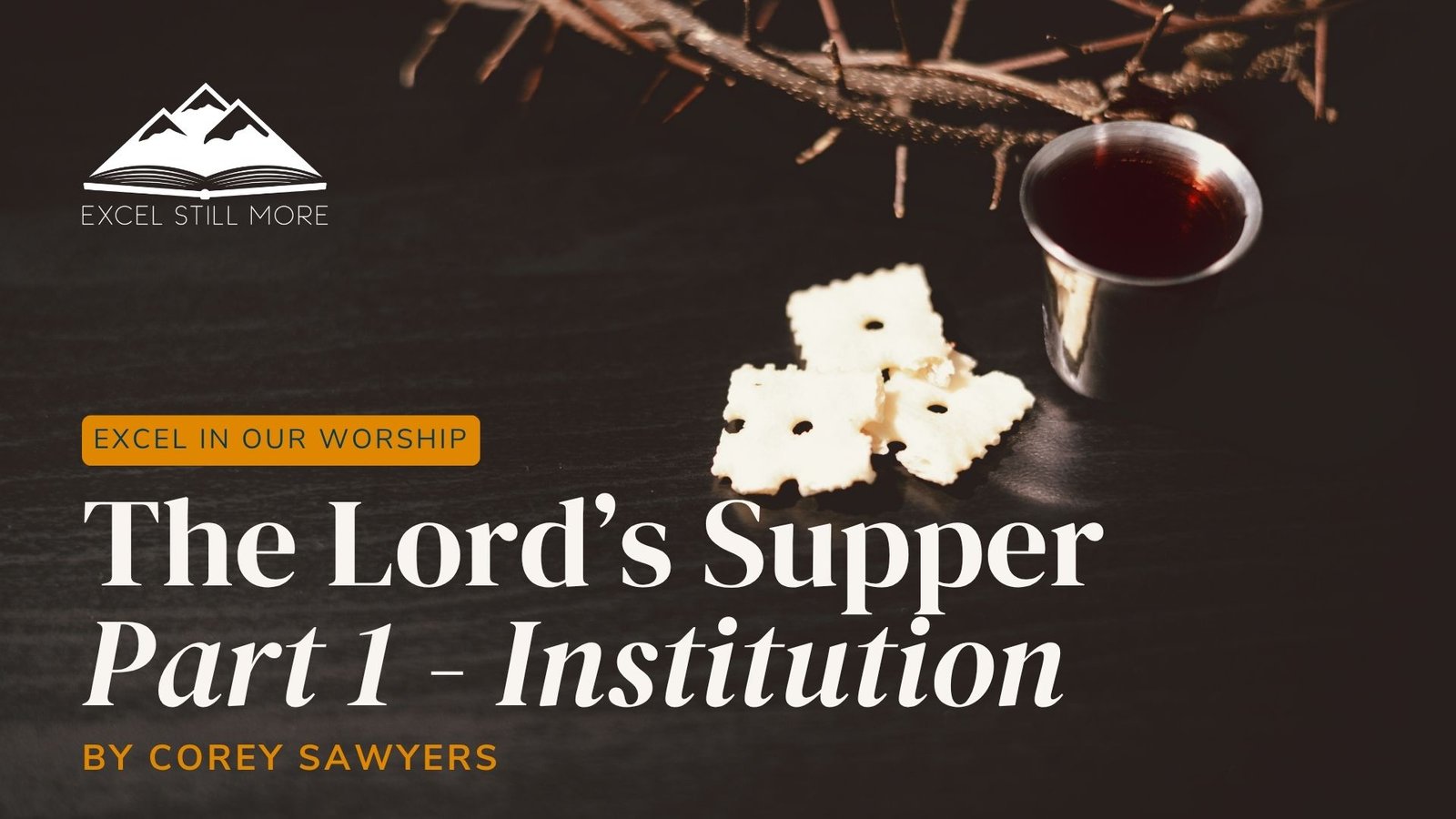
On the first day of each week, one of the things that we do in our assemblies is the partaking of the Lord’s Supper. This particular act of worship was instituted by Jesus, Himself, on the night of his betrayal. During the Passover Feast, in an upper room in Jerusalem, our Lord showed His disciples in what manner He wanted His followers to commemorate Him and His sacrifice for sins. Now as they were eating, Jesus took bread, and after blessing it broke it and gave it to the disciples, and said, “Take, eat; this is my body.” And he took a cup, and when he had given thanks he gave it to them, saying, “Drink of it, all of you, for this is my blood of the covenant, which is poured out for many for the forgiveness of sins.” (Matthew 26:26–28). Two other Gospel accounts record that moment in Mark 14:22–24 and Luke 22:19, 20.
Later, the inspired apostle Paul wrote to the church at Corinth to, among other reasons, instruct the brethren in regard to this memorial. 1 Corinthians 10:15–17 says, “I speak as to sensible people; judge for yourselves what I say. The cup of blessing that we bless, is it not a participation in the blood of Christ? The bread that we break, is it not a participation in the body of Christ? Because there is one bread, we who are many are one body, for we all partake of the one bread.” Later, in I Corinthians 11:23–29, he says, “For I received from the Lord what I also delivered to you, that the Lord Jesus on the night when he was betrayed took bread, and when he had given thanks, he broke it, and said, “This is my body, which is for you. Do this in remembrance of me.” In the same way also he took the cup, after supper, saying, “This cup is the new covenant in my blood. Do this, as often as you drink it, in remembrance of me.” For as often as you eat this bread and drink the cup, you proclaim the Lord’s death until he comes. Whoever, therefore, eats the bread or drinks the cup of the Lord in an unworthy manner will be guilty concerning the body and blood of the Lord. Let a person examine himself, then, and so eat of the bread and drink of the cup. For anyone who eats and drinks without discerning the body eats and drinks judgment on himself.”
The Lord’s Supper is a memorial instituted by Jesus that is a matter of frequently repeating obligation. The elements to be partaken of in this act of worship are the bread and the fruit of the vine. The purpose is to memorialize the death of Jesus. The act of communion is a prominent act of worship and it is central to the life of a Christian.
It would be beneficial for us to think about the foundation for doing such a thing. From where, or whom, did the act of communion originate? As one might determine from its title, the Lord introduced the supper Himself. Consequently, the basis or foundation of the Communion is Jesus Christ. Looking deeper into Jewish history, we can begin to see a clearer picture of what the Lord had in mind.
The institution of the Lord’s Supper took place during the time of the Jewish Passover feast. This was a momentous time of the year for the Jew. The Passover was a memorial meal within itself, commemorating the extraordinary and miraculous deliverance from Egyptian bondage. To save themselves from the tenth and last plague, the Almighty commanded the Israelites to kill a lamb, paint the blood of that lamb on the top and sides of their door frame, and remain inside of their homes. That night, when the Lord came to smite the firstborn of each Egyptian household, He would pass over every home which was accordingly marked by the blood of the slain lamb. We read of this in Exodus 12:21-23.
On the evening when God gave instructions to Moses regarding His plan for sparing the Israelites from His punishment of wicked men, He also purposed that the Israelites would celebrate this feast annually as a memorial of their salvation and deliverance from Egyptian bondage. The blood of the pure, innocent lamb saved them from the punishment they otherwise would have received. In partaking of the feast, they were to remember that sacrifice which saved them. In Exodus 12:14-20, it says, “…And you shall observe the Feast of Unleavened Bread, for on this very day I brought your hosts out of the land of Egypt. Therefore you shall observe this day, throughout your generations, as a statute forever…”
Later, in verses 23-27 of Exodus 12, it says, “For the Lord will pass through to strike the Egyptians, and when he sees the blood on the lintel and on the two doorposts, the Lord will pass over the door and will not allow the destroyer to enter your houses to strike you. You shall observe this rite as a statute for you and for your sons forever. And when you come to the land that the Lord will give you, as he has promised, you shall keep this service. And when your children say to you, ‘What do you mean by this service?’ you shall say, ‘It is the sacrifice of the Lord’s Passover, for he passed over the houses of the people of Israel in Egypt, when he struck the Egyptians but spared our houses.’” And the people bowed their heads and worshiped.”
By requiring His disciples perform this new ritual of the communion in His Own remembrance, Jesus made a bold statement, claiming significance at least equal to the Exodus. The time and Christ’s instructions also dictated precisely the use of the emblems – both what was and was not able to be used in the performance of this new ritual.
In instituting His Supper, Jesus mentions the “new covenant.” This terminology comes from a promise given by God in Jeremiah 31:31 to establish a New Covenant. The “covenant of peace” as it is called in Isaiah 54:10 and Ezekiel 37:26, is an “everlasting covenant” says the prophet in Jeremiah 32:40. The book of Daniel calls it a “covenant of love” (9:4). The Passover represented God’s blessing, grace and relationship between Him and His people under the covenant between the Israelites and Jehovah. In similar manner, Christ’s Supper would also represent blessing, grace and the relationship between Christians and the Lord. The New Testament derives its name from this new covenant.
The night of the first partaking of the Lord’s Supper was an extremely significant time, and not just because of the Passover Feast. Jesus was about to offer Himself as the perfect sacrifice for the sins of the world. He was the Lamb of God (John 1:36). He was slain for mankind (Rev. 5:12). This perfect Sacrifice shed His blood (I Peter 1:19) and became the Christian’s Passover. I Cor. 5:7 says, “Cleanse out the old leaven that you may be a new lump, as you really are unleavened. For Christ, our Passover lamb, has been sacrificed.”
As a result of Jesus’s crucifixion, humankind is no longer permanently subjected to the sentence of death as penalty for sin. Just as the Passover reminded them of their miraculous delivery from the bondage of the Egyptians, the Lord’s Supper is a reminder to the Christian of his or her delivery from the bondage of sin. Within the Communion, the deepest mystery of Christianity is embodied ever anew, and the story of the cross reproduced before us.